OrangeMethod
Technology Onboarding
OrangeMethod’s Technology Onboarding is designed to be the bridge of transition for new Tech associates into The Home Depot’s tech ecosystem. The program immerses new hires in organizational values, tech strategy, best practices and tooling, and Product Team methodologies and ways of working. The Vision: Transform a high-friction, static onboarding program into an interactive, high engagement, measurable learning experience , equipping 400+ new technologists for role readiness, increased time to productivity and contribution, and satisfaction.
Lead Researcher, Service & Instructional Design
As the Lead Researcher and Instructional and Service Designer for 3+ years on this initiative, I moved the program from a “gut feeling” model to a data-driven learning ecosystem. I was responsible for the end-to-end design of the new hire journey, the longitudinal feedback loop, optimization of internal team processes, curriculum transformation, and cross-functional alignment.
My work on this program was about designing a sustainable system of improvement. My contributions as the user experience lead helped create an environment where new hires felt empowered, managers felt supported, and the business saw measurable ROI.
Longitudinal Feedback Loop and Research
Monitoring program health from implementation to long-term role readiness.
Persona & Journey Development
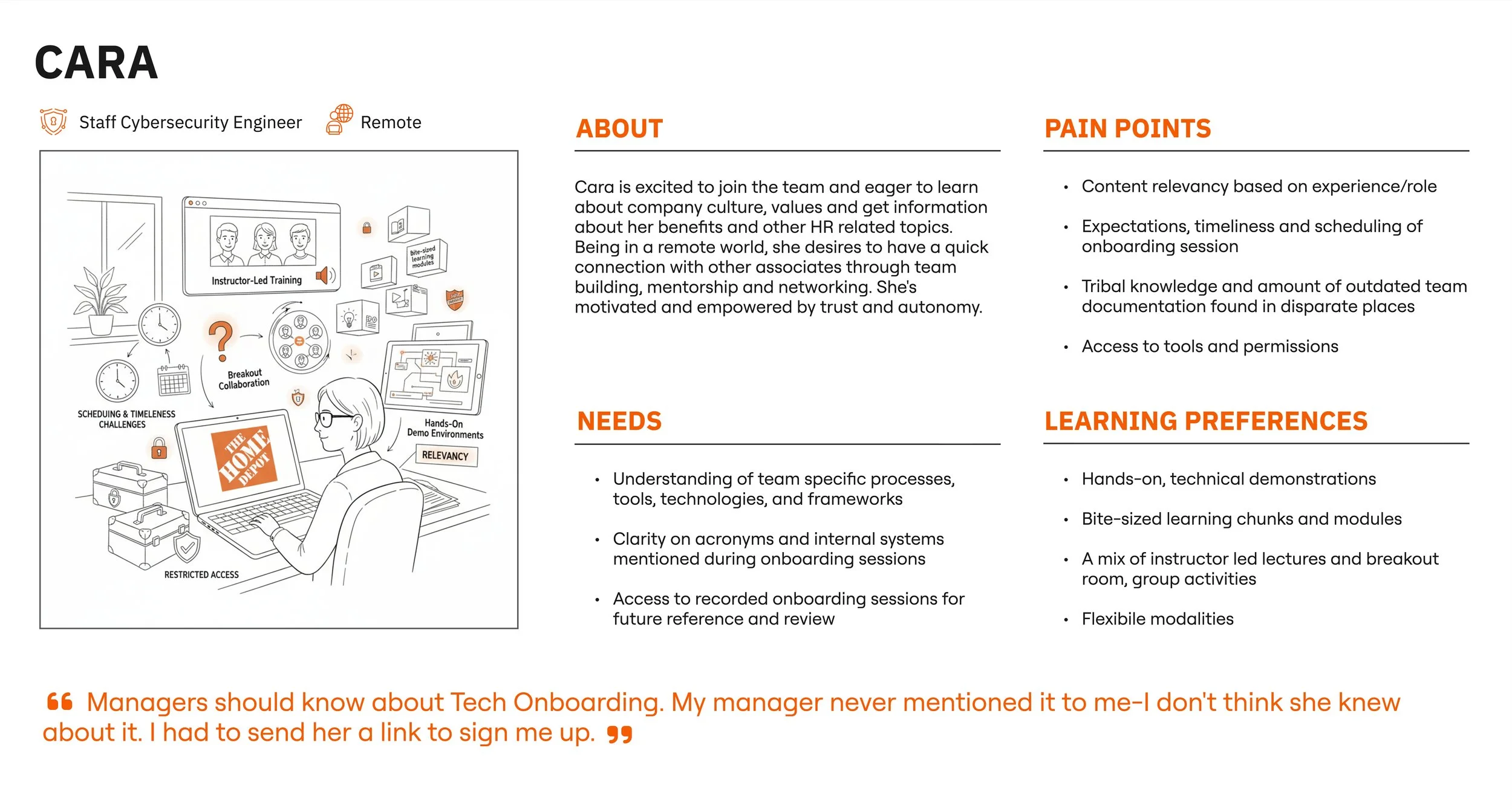
Identified and mapped journey for New Hires within the OMOW Tech Onboarding experience and developed personas for New Hires (Primary) and Hiring Managers (Secondary), recognizing that manager satisfaction is a critical downstream metric for onboarding success.
Multivariate Data Collection
Designed, monitored and reported on a suite of quantitative and qualitative evaluative tools, including end of training and NPS surveys, 90-day pulse checks, hiring manager surveys, interviews and stakeholder retrospectives.
Data-Driven Iteration
Analyzed trends on a monthly basis to drive two-week sprints, allowing the team to make surgical, incremental improvements to content and delivery.
Service Design and Process Optimization
To transform fragmented processes into a seamless service ecosystem, I looked beyond the “classroom experience” to the bigger picture to map the Service Blueprint, uncovering 20+ hours of monthly waste.
Service Blueprint
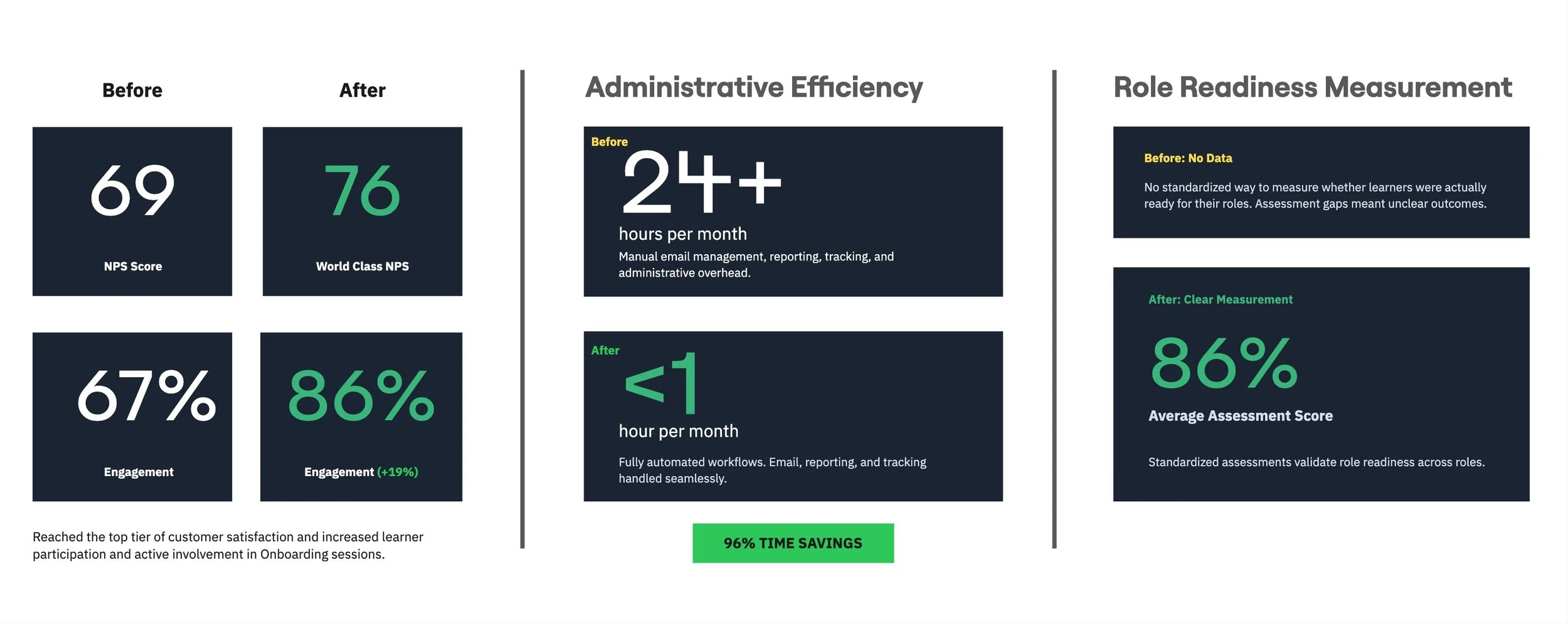
Transitioned the curriculum from static lectures to scenario-based learning activities and other interactive, group exercises, shifting the needle from passive listening to active doing. This transformation drove a 19% increase in learner engagement (from 67% to 86%).
Led the visual and pedagogical overhaul of the learning content and curriculum to reduce cognitive overload and increase engagement.
Scenario-Based Learning
The Challenge: Stagnation in curriculum updates due to a series of unorganized meetings without outcomes and lack of alignment between our team and Software Engineering leadership and SMEs.
The Solution: Instead of just updating curriculum content, I stepped in and acted as a bridge between learner feedback and business needs to move the needle on development and delivery. I designed a structured workshop called an “Idea Napkin,” translating requirements into actionable learning objectives.
The Impact: Stakeholder buy-in and prioritization for a clear roadmap to curriculum updates for Software Engineering learners-based on learner feedback and business needs. The updates including Cybersecurity trends and Data Warehouse insights, provided a broader “Service Design” perspective of the tech ecosystem, making new Software Engineers more versatile and security-conscious engineers.
The Facilitator Experience
Recognizing that the instructor is part of the “service,” I stood up a feedback loop and quarterly retrospectives, resulting in the design of Interactive Facilitator Worksheets. This lean documentation drove instructor success and allowed instructors to pivot in real-time, facilitating higher participation through curated prompts and Slack-ready resources.
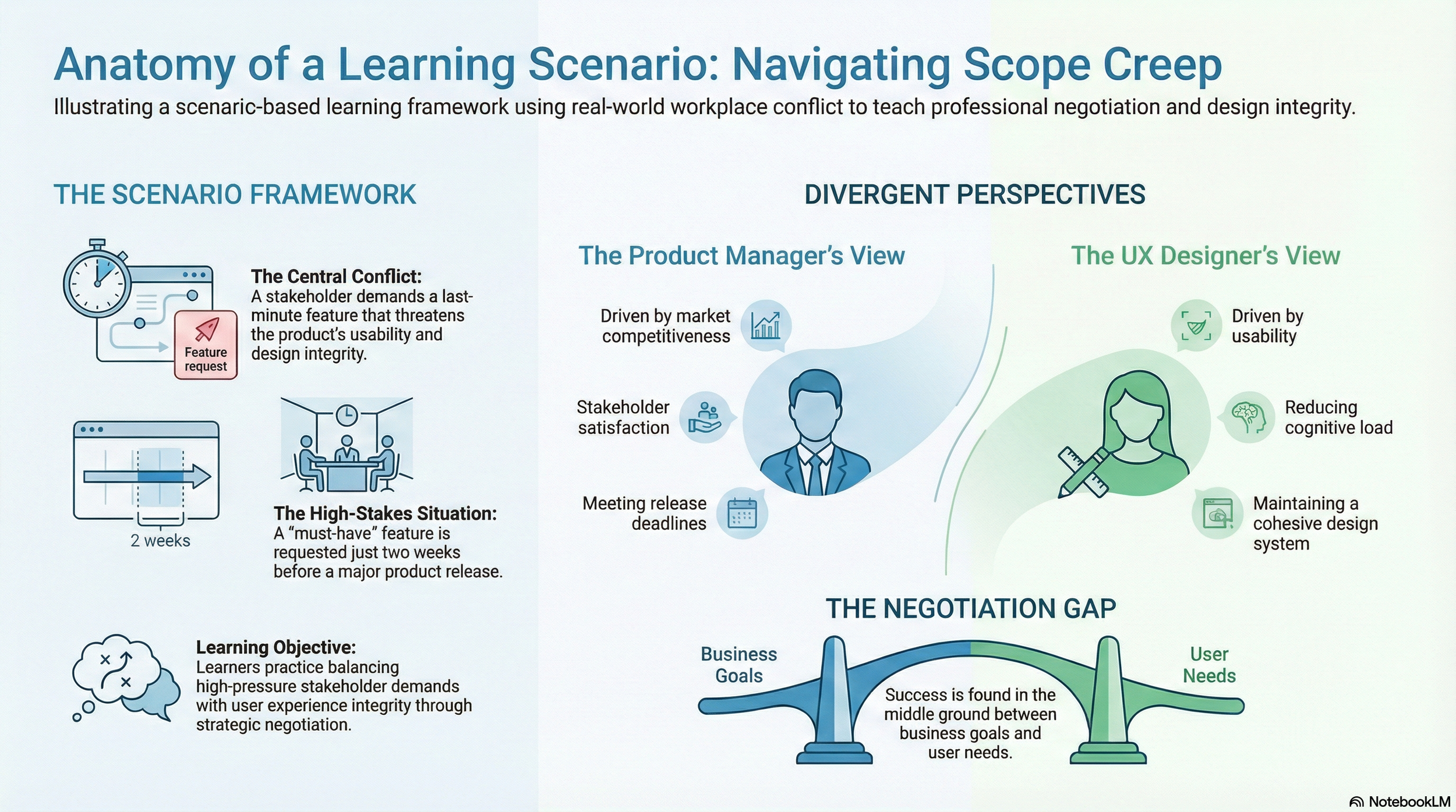
The “Scope Creep” vs. User Value
The Players: UX Designer & Product Manager
The Situation: Two weeks before a major release, the PM receives feedback from a key stakeholder that a new “must-have” filtering feature is needed. The PM wants to squeeze it into the current spring. The UX Designer knows that adding this without proper flow redesign will clutter the UI and confuse users.
Learning Objective: Practice balancing stakeholder demands with user experience integrity through negotiation.
The Perspectives: PM is focused on stakeholder satisfaction and market competitiveness and the UX Designer is focused on usability, cognitive load and maintaining a cohesive design system.
I designed and led structured, participatory workshops to bridge the gap between our team and cross-functional stakeholders, transforming undefined scope and requirements into actionable roadmaps.
Strategic Collaboration: Driving Results and Alignment
Ecosystem Mapping: Combining UX rigor and strategic facilitation, I partnered with HR, Comms, Talent Acquisition and the internal team to identify manual process bottlenecks, content overlap, email and comms fatigue and visibility gaps.
Internal Tooling & Data Transparency: Developed a self-service dashboard for stakeholders, that replaced manual-data mining for reporting purposes, with instant transparency into NPS health, program reach demographic insights. This eliminated close to 4 hours/month of manual data gathering and reporting.
Automation Strategy: Partnered with Engineering to identify “low effort, high value” automation opportunities to eliminate administrative overhead, including participant intake, e-mail communications, scheduling and survey distribution.
Eliminated Manual Friction: Reduced manual output from 266 emails per session to zero.
Time reclaimed: Saved Project Manager 20+ hours per month by automating scheduling, intake and comms.
Instructional and UX Design: Complexity into Clarity
Cognitive Load Optimization
I inherited a visually inconsistent, fragmented, text-heavy 100+ slide deck as the main modality for training. Using a UX lens, I applied branding consistency and accessibility standards to decrease cognitive load, allowing learners to focus on complex tech topics rather than deciphering slides.