“AI doesn’t replace the creative process; it demands a better one.”
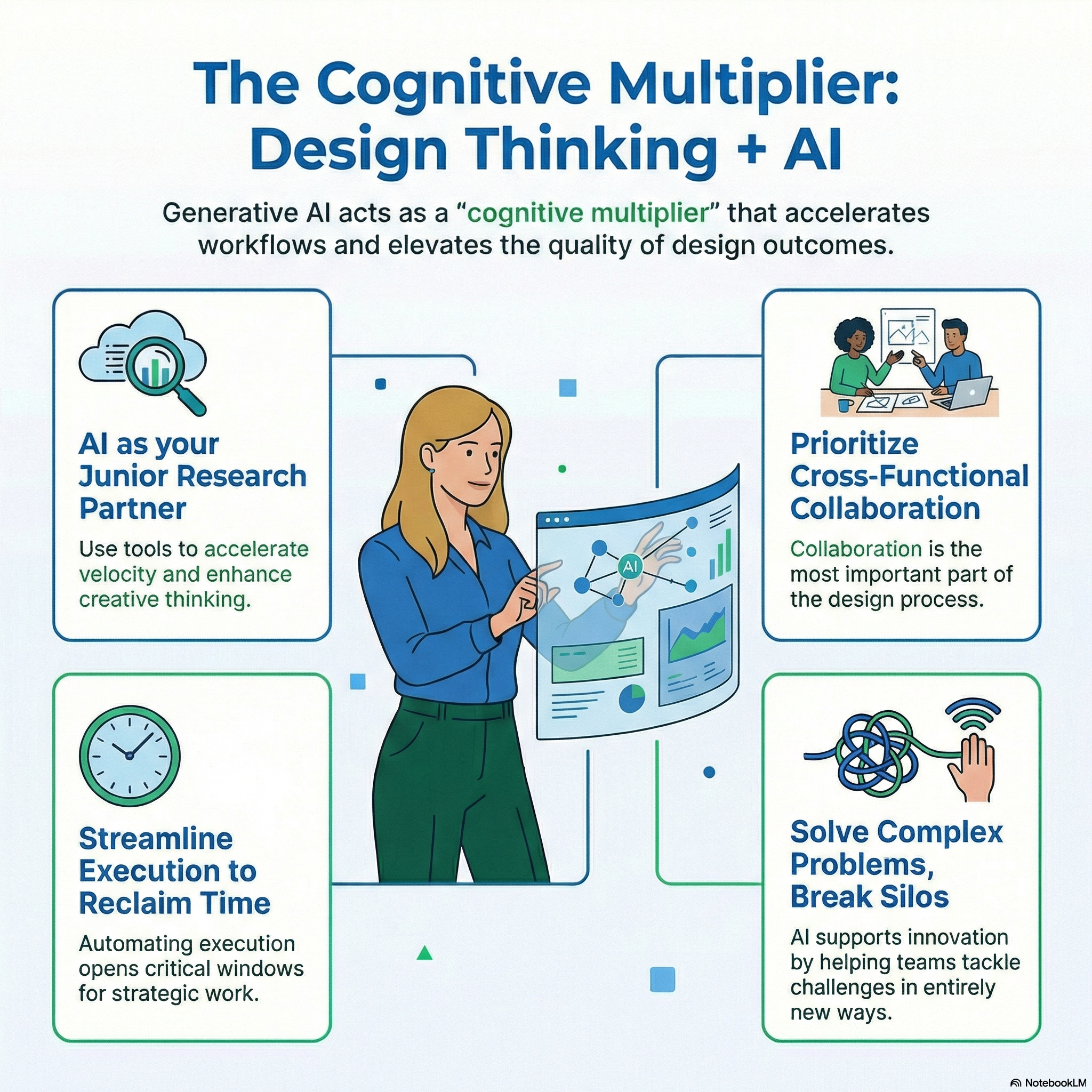
I view Generative AI as Jr. research and design partner to help accelerate the velocity of my work flow, but most importantly, to make my work smarter, more creative and more innovative. GenAI tools are a cognitive multiplier that enhance the Design Thinking process and that elevate the quality of final outcomes.
By streamlining execution, AI opens up critical time for cross-functional collaboration, which I believe is the most important part of the work. Ultimately, the most exciting value of AI is not just efficiency-it’s how it supports our ability to solve complex problems in entirely new ways, while breaking down silos. Below is an example of where I have integrated this philosophy into my practice.
Case Study
An AI-Integrated Work Flow
I led a team of designers, incorporating an end-to-end workflow where GenAI acted as a force multiplier, moving from strategic planning to content creation, and finally to deep data analysis.
The Challenge
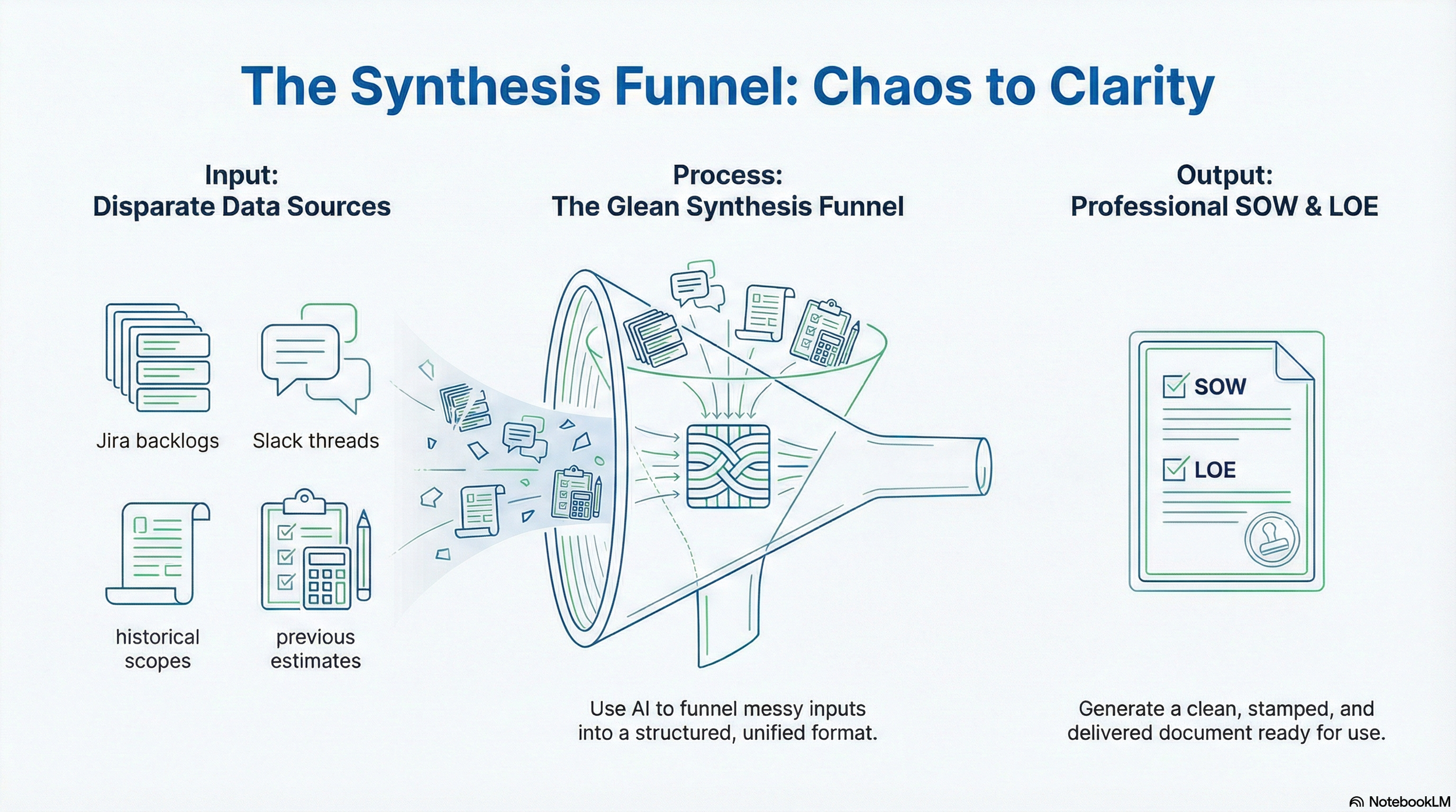
Leadership required detailed LOE (level of effort) estimations and an SOW (Statement of Work) immediately, following the loose definition of scope. Manual compilation would have taken days we didn’t have.
The Opportunity
Midway through the development of Part 2, leadership hired an external consultancy to manage the full rollout, knowing our internal team, though tiny but mighty, was resource scarce for handling such a large scale. However, I knew this was a risk: outsiders lacked our deep institutional knowledge, our specific engineering context, and the trust we had built with SMEs.
Data Sources
Role: Lead UX/Instructional Designer, Research and AI Strategist
Tools: Glean, Google Gemini Enterprise, NotebookLM, Miro
Methodologies: Agile, Double Diamond Framework, Bloom’s Taxonomy, ADDIE
Phase 1 : The Fast-Track LOE and SOW
Accelerated Definition and Strategy (Glean)
The AI-Assisted Solution
I leveraged Glean to retrieve and synthesize our organization’s historical estimation data and project scopes from similar, past initiatives.
Phase 2 : Curing the Blank Page Syndrome
Curriculum Development (Glean, GitHub Copilot & Gemini)
The AI-Assisted Solution
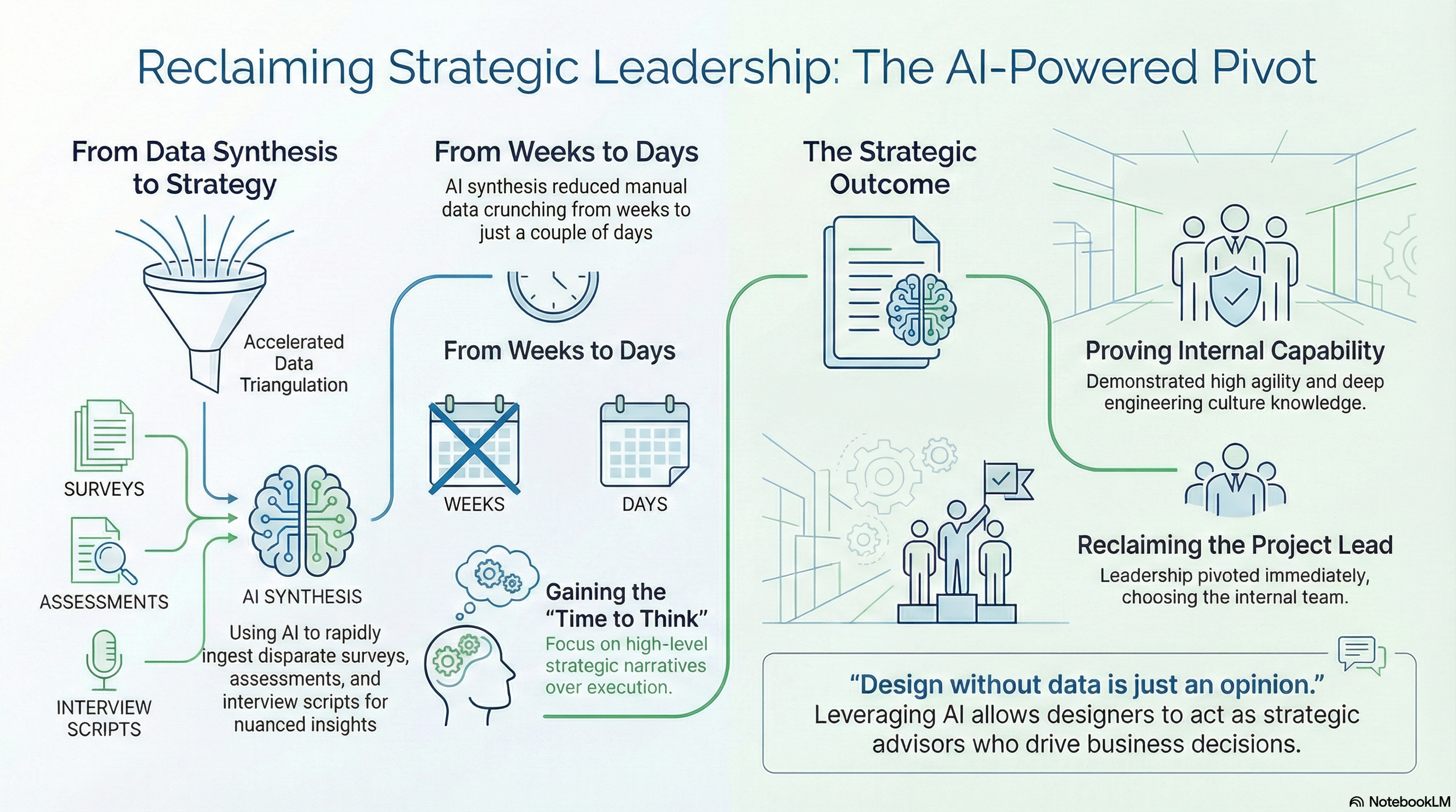
With a tight-turn around between pilot close and our readout date, I used Gemini and NotebookLM to rapidly ingest disparate data sources (surveys, assessments, impact metrics and interview scripts) so I could “query the data” to find nuanced connections between learners sentiment, assessment scores and business impact.
The Shift: Instead of spending weeks manually triangulating qualitative and quantitative data, AI assisted me in identifying key themes and sentiment patterns needed to develop actionable insights within a couple of days.
The Benefit: This speed brought me the most valuable resource of all: time to think.
The Impact
Speed: Delivered a data-backed LOE and SOW within hours, not days.
Trust: The accuracy of historical data reduced risk, giving leadership the confidence to green light the pilot immediately, allowing us to move swiftly into development, moving the needle towards delivering value.
The Challenge
A team of non-engineers were accountable for creating a practical, hands-on, immersive and technical learning experience for Software Engineers, within a tight deadline.
The Opportunity
I identified a critical gap in our user journey; our engineers needed a technical refresher between Part 1 and Part 2 of the pilot to address readiness to learn and the “forgetting curve.” However, our capacity was tied down with our IXD’s in mid-development while I was focused on the feedback loop and measurement.
The AI-Assisted Solution
Outcomes & Objectives: I used the Bloom’s Taxonomy framework and our defined success measures and worked with Glean to create a set of technical and practical Learning Outcomes and Objectives.
Drafting: We used Glean and GitHub Copilot to retrieve internal documentation on AI tooling and coding practices at THD and mapped them to the Learning Outcomes and Objectives to develop a first draft of curriculum materials.
Phase 3 : A Living Podcast & Microlearning Experiment
The AI-Assisted Solution
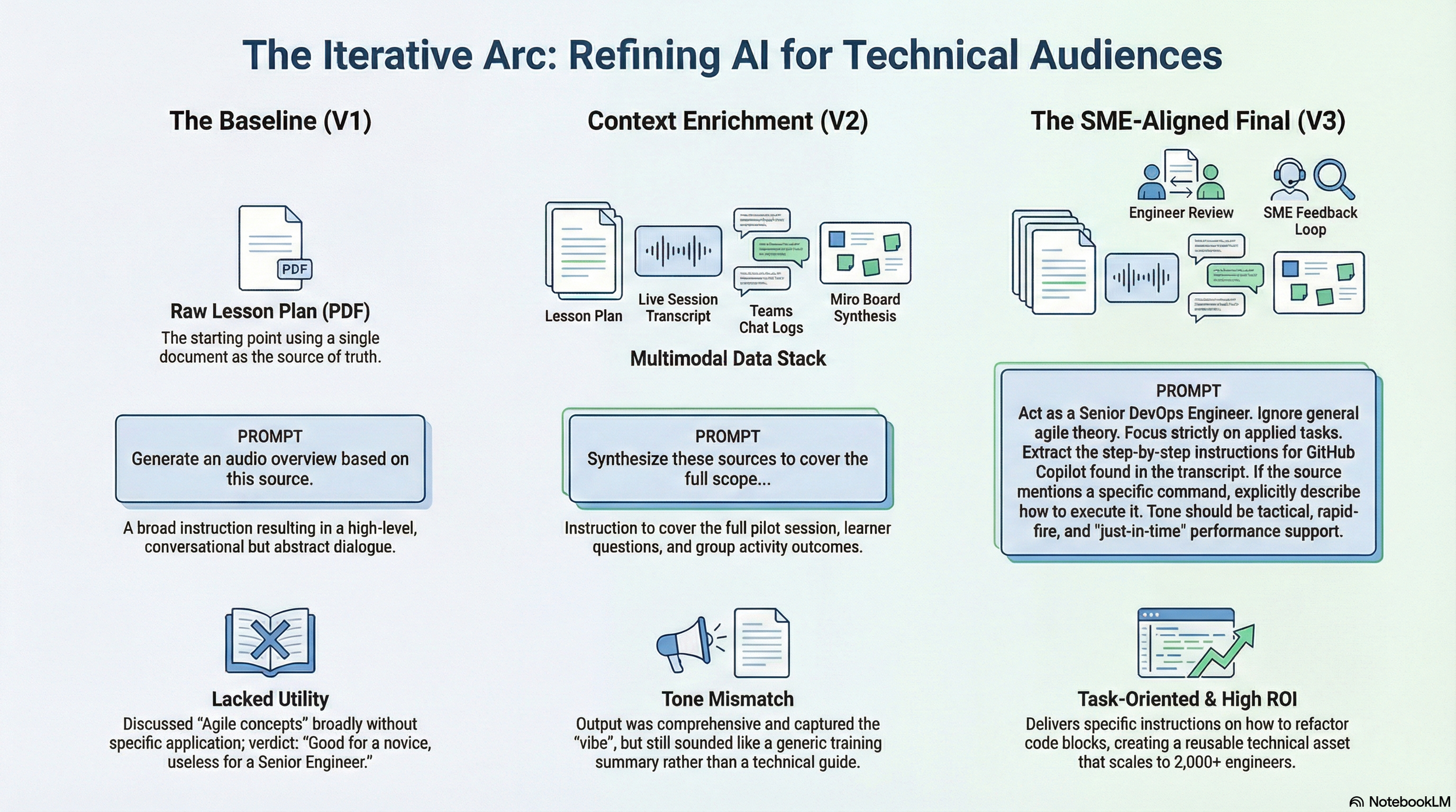
I hypothesized that we could leverage GenAI to solve this, so I curated our raw documentation, transcripts, and chat history to prototype an AI-generated 'podcast' experience.
But I didn't just ship it; I wrapped it in a research layer. I integrated targeted survey questions and followed up with user interviews to validate if this was just a novelty or a viable learning modality. I carefully curated the context sources (lesson plans, live session transcripts, session chat logs) used iterative prompting and feedback from an Engineering SME to shift the tone from “theoretical” to “step-by-step” technical application for GitHub Copilot.
The Outcome
At the end of the readout, our Distinguished Engineer and owner of the initiative asked a set of questions, paused and made an immediate decision — “I want to take the consultancy off the lead and have this team lead the way.” Our Senior Manager called a team-wide, last minute meeting immediately after the readout to call for all-hands on deck and tell the team of a shift in priorities.
Why This Matters
Design without data is just an opinion. By leveraging AI to accelerate data synthesis, I was able to move beyond execution and act as a strategic advisor. I didn’t just design a course; I used data to design the business decision that kept the project internal, ensuring the experts and the engineering culture remained the heart of the rollout.
Garbage in. Garbage out.
Prioritize primary and trusted sources.
Curate data that addresses the why and outcomes of the results I’m looking for.
Ensure sources are up to date.
Remove noise such as irrelevant information, redundancy and normalize format.
Segment and chunk large documents into small, cohesive themes.
The Impact
This was an Agile win and allowed us to bypass the blank page and get materials into the review cycle with Subject Matter Experts (SMEs) almost immediately, significantly speeding up our time-to-market. This allowed them to make recommendations on improvement and edits without asking them to write the technical components from scratch.
The Impact
A static lesson plan was transformed into a portable, high-value technical asset and opened the opportunity to experiment with this new modality.
Validated Modality: Through branching surveys and post training interviews, we validated this as a viable, complementary modality to increase reach and maximize ROI. Engineers saw the NotebookLM audio overviews as an “interactive pairing buddy” that they could access at point of need during their coding work flows.
Scale: Demonstrated we could turn static curriculum assets into high-fidelity, applicable learning modules without increasing headcount, in under an hour.
Phase 4 : Power of AI to Amplify Human Influence
Evaluation (Gemini & NotebookLM )
The Narrative & Pivot
Freed from data crunching, I focused entirely on crafting a persuasive strategic narrative for our readout. I used the insights to build a data-backed case that our internal team was the most capable group of delivering this specific ROI.
I highlighted our agility, our high-performing team dynamics, and our unique understanding of the engineering culture and our ability to deliver measurable results.
I elevated our context-aware approach, emphasizing its benefits over something potentially generic.
My Generative AI Principles
Prompt Engineering
Treat prompts like design or code, iterating or refactoring based on feedback and quality to improve accuracy and relevancy.
Compare different variations with different tools to find highest consistency results through A/B testing.
Provide rich context such as background information, intended audience or any constraints.
Assign persona to help AI adopt the right tone, style and knowledge base.
Human-in-the-Loop
Run initial queries to audit what sources the AI is using.
Monitor and remove biased information that might skew analysis or results.
Run review cycles with subject matter experts to ensures accuracy and tone.